 Projects
About Me
Projects
About Me

My short film, Inaperçue, follows a high school girl, Soline, through her first few days of school. It encapsulates the paradox of: When people don't notice you, you wish you were noticed: When you're in the spotlight, you wish you were invisible.
I find Soline’s story very relatable. I'm a relatively quiet and introverted person. There are times every day when I feel like Soline. Times like raising my hand for ten minutes while the teacher helps someone who has had their hand up for one minute. Little experiences like that were a major inspiration for this film.
I've been animating on and off since 2021 (11 years old) so I did have animation experience before starting this project. I had made short animations for Art Fight and my characters, but nothing longer than 30 seconds. I recommend getting familiar with the basics of animation before jumping into a big project, but If youre excited about a project of your own and want to start right away, go for it!
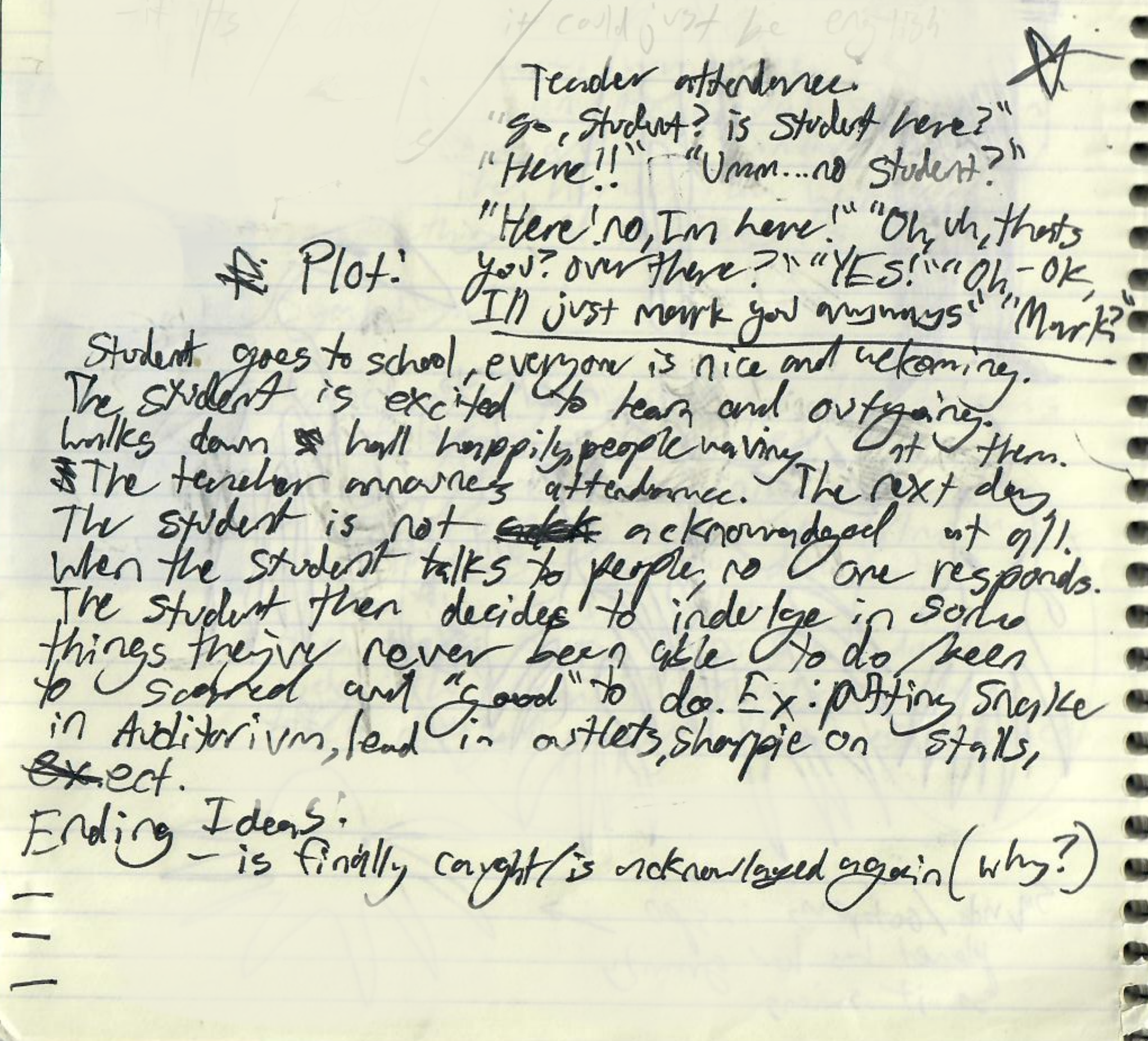
Film bros will tell you that you need to follow outlines and think out every plot hole of your story. It’s important that you don't do this. You won't want to stick with your project if you're not personally in love with it at the start. Don't worry about story structure too much. Just start the first thing you feel really passionate about, despite its flaws. This doesn't mean go with your first idea. It means to go with the first idea that you just can't stop thinking about. Even if you don't have an ending thought out, JUST START!!!
I actually didn't know my ending until I had to animate it! I don't necessarily recommend doing this, but if you have a good plot and message you want to tell, you'll find a good ending along the way.
I give this tip mostly because finding endings and worrying about how “critically” good your film is will only demotivate you. Here is a picture of the first documentation of my story.
Make your film for YOU. Not the Oscar critics.
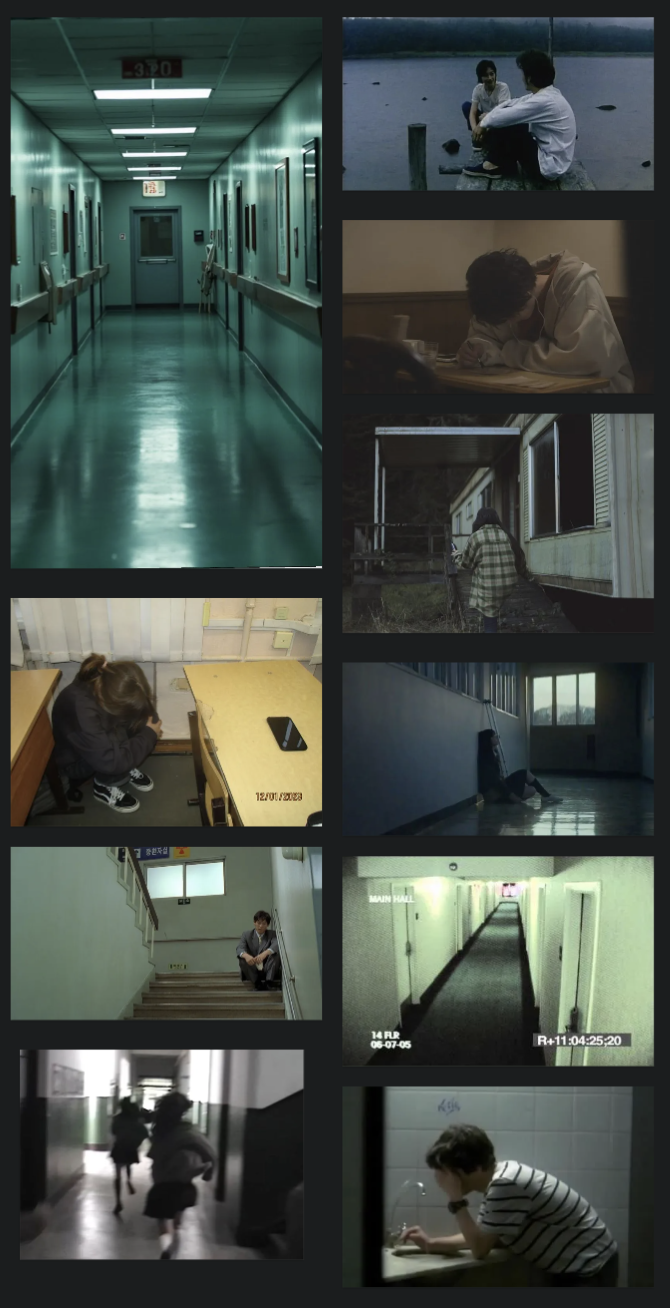
Create mood boards, consume a TON of media with your intended vibe, create music playlists, collect everything you can that remotely resembles how you imagine your final product. Things I use for this stage are pinterest, Thinker Cloud, and notion to organize my thoughts. Some examples of media that inspired Inaperçue are Cry of Fear, The Backrooms, and Don't Starve.
Here is a picture of my Pinterest mood board for Inaperçue. I have also embedded the Spotify playlist I used for the music inspiration.
This is an important step because having direct references for your film will save time and confusion in the beginning. It will help you stay consistent and get you inspired.
★Which animation/drawing program? → Krita
★What backgrounds? → Real life backgrounds w/ a Panasonic Lumix Dmc-lx5 camera found in my garage
★Canvas size? → 1249x840: same ratio as my camera’s images
★Which editing program? → ClipChamp (Please don’t use this omg its so bad)
★Who will make the music? → My brother!
★Who will be the actors/voice actors? → Some friends from school
If all you have is something old, use it! If you don't know someone to make music for you, try and learn it yourself or use royalty free tracks.
I can only recommend Krita for animating personally, but I know OpenToonz is also a free option. I wouldn't recommend Flipaclip or procreate but I know some people stand by them.
Do whatever you're comfortable with for your first film! You don't have to worry about experimenting or being professional. This is your first film and making a film itself is a challenge.
It's not all about the character though, let's talk about backgrounds.
If you don't want to draw backgrounds, you can take pictures of real places OR it might be worth it to 3D model your background so you can take pictures from any angle at any time. 3D modeling can be scary, but making a simple background might be worth trying.
If you don't want to worry about texturing, you could also use it as a reference to draw over. People also sometimes use The Sims or Minecraft for room references.
The reason why many people hate backgrounds is because they don't know where to start. Having a clear guide is needed.
There's no wrong way to storyboard, but what I did was I first drew the boxes and scenes in my sketchbook. Later, I digitally drew my storyboards using a template.
Here is a link to a google drive including my storyboards and an animated Krita file that I used as I finished scenes. Below is a photo of my paper storyboard
This is where it gets fun! Take your boards and inspiration from step 2 and use them to help with this step.
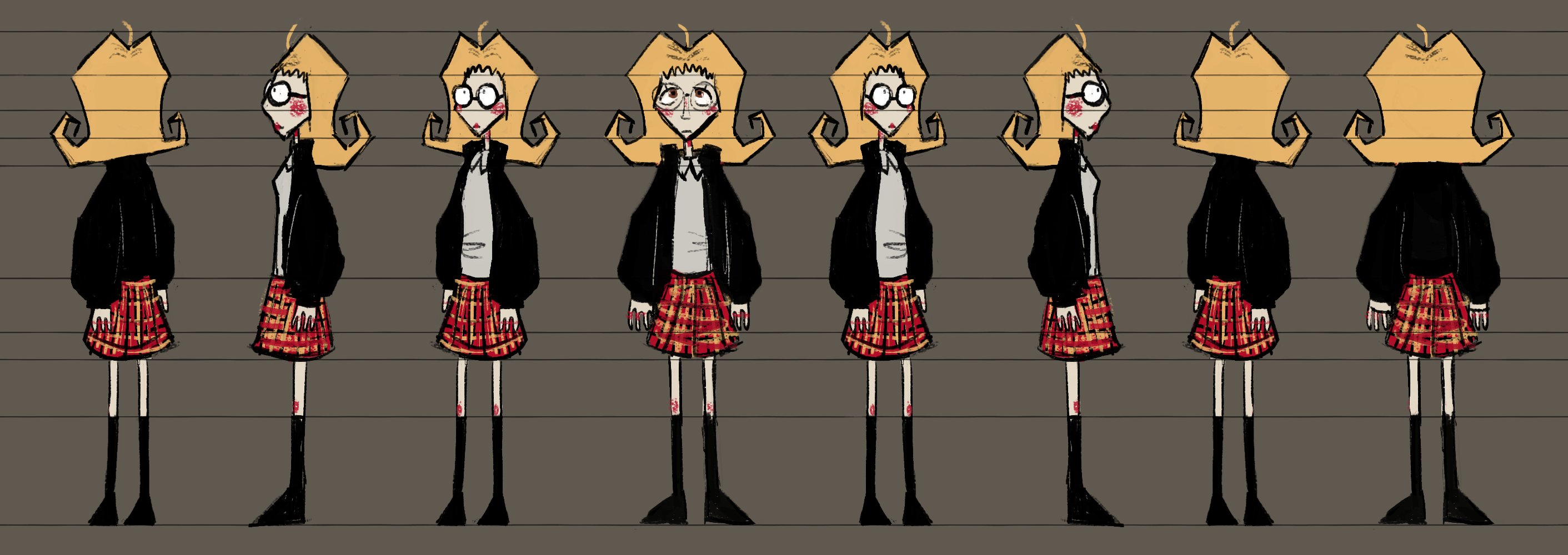
When designing a character that's going to be animated, make sure to balance speed, recognizability, and color.
The most important part of an animated character is how fast it is to draw. Make sure to change how you'd usually draw anatomy to easily draw. For me, that meant simplifying Soline’s legs into sticks.
Your character also should aim to be recognizable. You can easily do this with fun shape language. The main thing that makes Soline have a recognizable silhouette is her hair’s curls.
Your character has to stand out but also fit into the world around them. I made Soline bright blonde and used that color in her skirt as well to tie it together. After coloring, I would put a subtle gray overlay on top to desaturate her colors and make her fit into the environment.
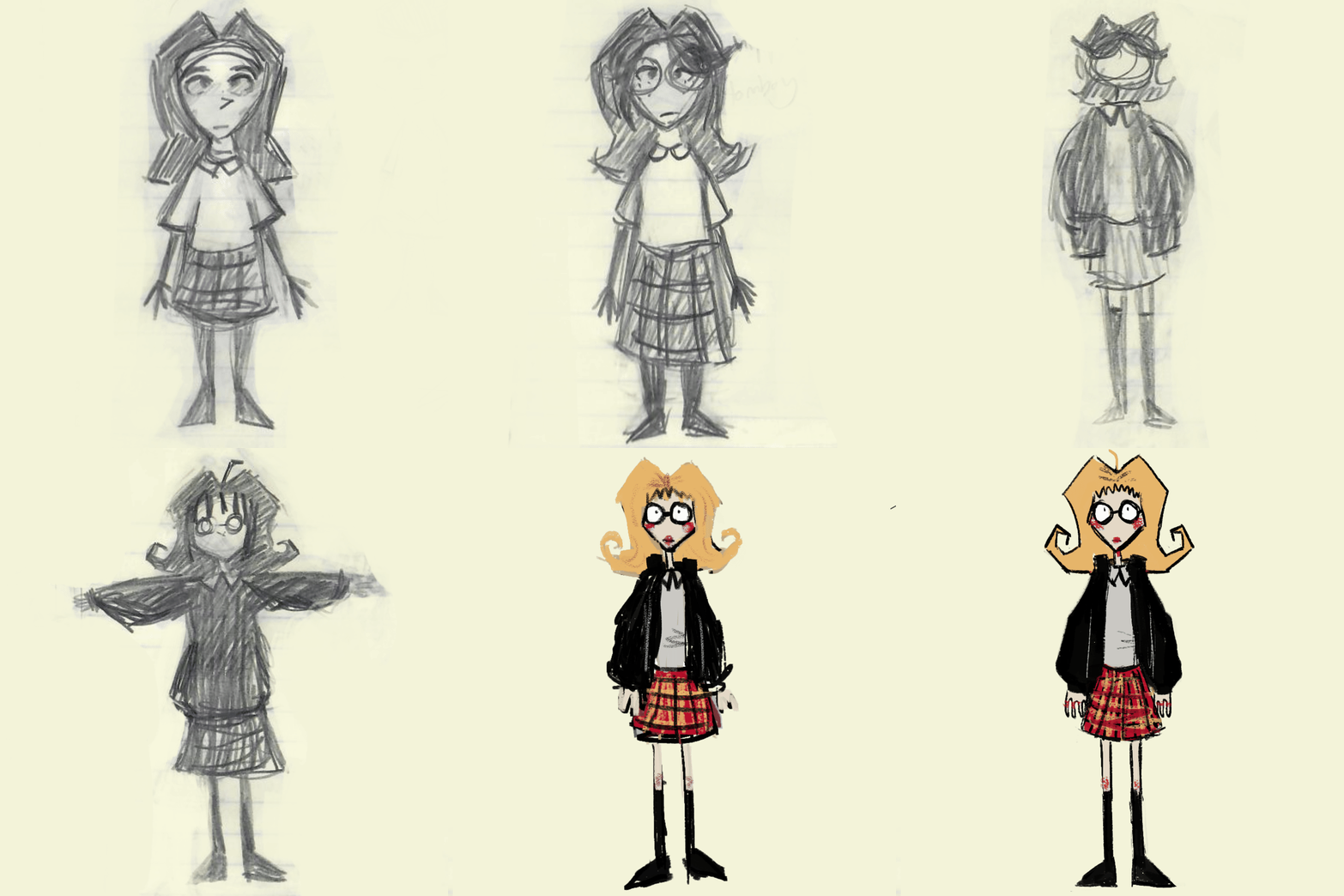
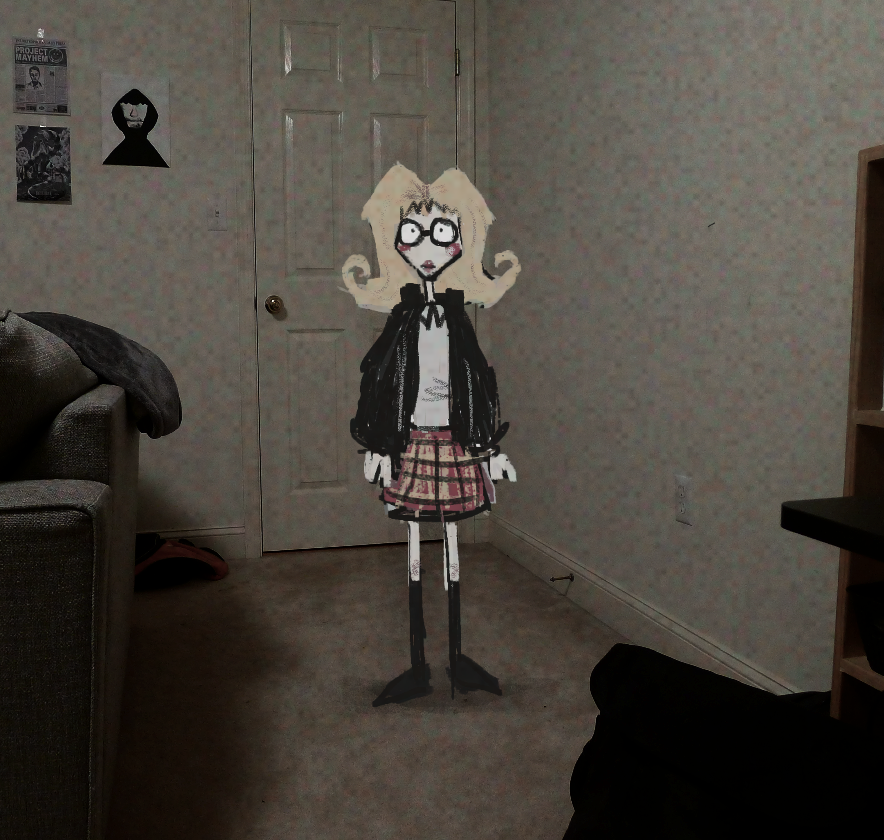
Here is a gif including all my sketched versions of Soline leading up to her final design and the first drawing with soline in the real world.

If you learn anything from this whole page, make sure you understand this.
My biggest regret in making this film is that I didn't prioritize the voices at all. I didn't finish collecting the attendance voices until THE DAY BEFORE IT WAS DUE!!! I didnt start collecting Solines voices until I was halfway done with all the scenes. I had to reanimate a few to make them match the voice timing.
This could have all been avoided by just focusing on the voices before animating. If your actor isn't working with you or making it difficult, QUICKLY FIND A NEW ONE. Don't worry about being “rude”. This is your project, you have the right to change the lead actor if they're not fitting the role like you thought they would. If you're introverted, this might honestly be the hardest step. Just get it over with!
I started by taking my background pictures/videos. I had some friends who were able to model for me and give me references to follow. You can do this yourself, but I found it fun to do with others.
I recorded the model doing the action and animated Soline on another layer. Most of the hallway scenes have a real person hiding on the layer below Soline. It helped me figure out how a real person would look in each scene instead of following robotic walk cycles.
My overall process consisted of animating each scene in seperate krita files. After animating each scene, I would add it to a master krita file with my storyboard (see step 5's link for the file). After a while though, I switched from adding them to the storyboard file, to my editing software.
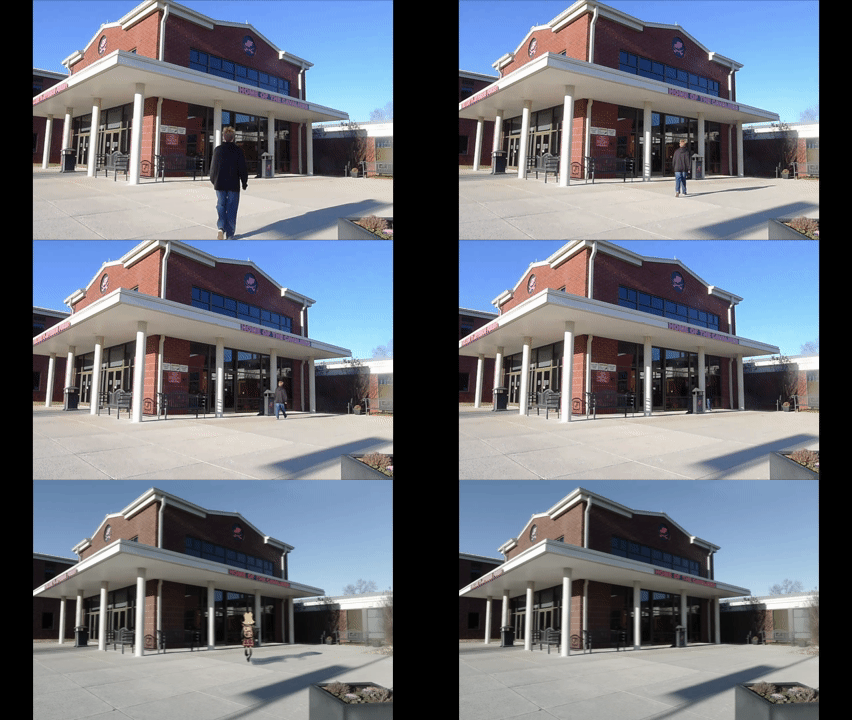
Above shows the reference video for the first scene of the film.
You can do this step anytime, but it ideally happens when all animation is finished. I was struggling to make the deadline so I had to send over my animation before it was fully finished. It had enough for my brother to use for music reference, but it was an extremely scuffed version of the final product. It had no sound effects, no attendance voices, the credits were arial font, and the end scene was barely colored.
I told my music producer (older brother) I wanted the opening credits to have a melancholy, bittersweet, first day of school feeling. He got that track perfect on the first pass, but the ending music took a second pass.
For the ending music, I told him I wanted it to increasingly get more crazy as it went on. I also gave him the song All My Friends by LCD Soundsystem as a reference. The first pass was a bit too joyful for my liking and also started too loudly. I told him to make it turn more scary towards the end and have a crescendo leading up to when she throws the computer. The second pass was perfect and is what you see in the final film!
He finished it in only 2 days, but always make sure to give yourself more time than you think you'll need if you're making it yourself or hiring someone professionally.
You can get a sound designer for this if you know one, but it's relatively easy and tedious. My brother has done sound design for other short films but I knew I was going to be knit-picky so I did it myself. I found some free hallway background sounds, nature sounds, and bus sounds. Your setting and actions might require crazier sounds, but just do whatever sounds good to you.
Show your family before finishing. They will probably tell you it's completely perfect, but if they do say anything about small changes you can make, consider adding them.
After that, show any experts you know in theatre or film. Many people suggested I put my credits at the end in order to clearly signal the end of the film, but I knew my credits were long and I didn't want to have such a sudden mood shift. I had a lot of reasons it needed to be at the start, so my school’s theater director told me to put a simple title screen at the end to still signal to the audience the film was finished.

You need to finish your film for your past self.
You need to finish your film for anyone who would love your film even if it's one person.
You need to finish your film so you can say you did.
You don't ever have to make another film, but you might as well make one!
Thank you so much for reading to the end!
If you have anything to share or any questions, please leave a comment!
Sign into Chattable to change username!